
The View From The Summit: Finding Purpose After Your Business Exit
Key Takeaways:
- Selling Your Business Can Open the Door to a New Chapter Filled with Possibility – Many former founders discover that letting go of the day-to-day responsibilities that come with owning a business creates space for renewed curiosity, personal growth, and new passions.
- Success Creates the Freedom to Pursue Meaning More Intentionally – Rather than chasing the next milestone, entrepreneurs can focus on activities and relationships that bring deeper and more sustainable fulfillment.
- A Satisfying Post-Exit Life Often Means Redefining Identity and Purpose – Instead of one big “next thing”, focus on building a “portfolio of purpose” (mentoring, hobbies, volunteering, learning, etc). Thoughtfully reconstructing daily structure helps many former founders find fulfillment again.
Selling your business is a significant milestone that brings financial freedom and a sense of achievement as you’ve built a company and taken it across the finish line. After the sale, you have the opportunity to define your own terms for future success.
But here’s what I’ve observed after working with dozens of entrepreneurs post exit: the view from the summit looks different for everyone. If you’re preparing for or currently navigating a business exit, it helps to know the terrain ahead. Let me share what I’ve seen and what research tells us about this unique transition.
Three Common Post-Exit Experiences
It is useful to view post-exit experiences as a continuum, ranging from a smooth transition at one end to malaise at the other:
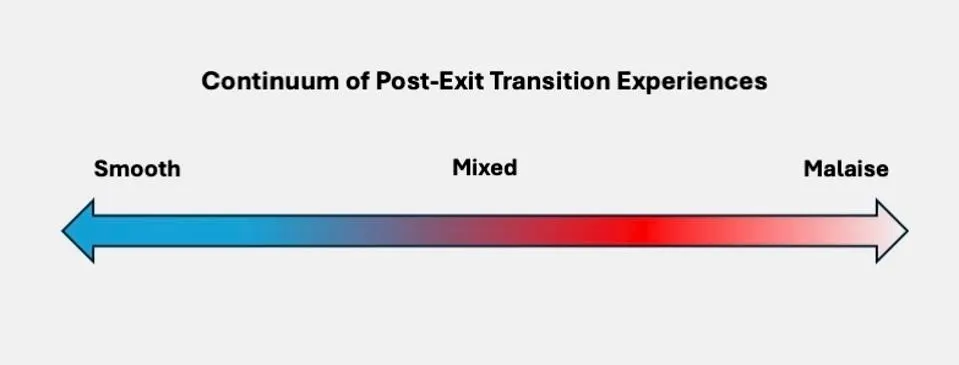
1. Smooth Transition
Some entrepreneurs seamlessly flow into their next chapter after an exit. They have been mentally, emotionally, and financially preparing for this moment for years. They have hobbies waiting, new enterprises to pursue, relationships to strengthen, and causes to support. For them, the exit marks the start of something they’ve been looking forward to. If this describes you, great. Savor every moment.
2. Post-Exit Malaise
Others find that selling their business creates a void. Years ago, I met a founder—let’s call him David—who experienced this. He had sold his company for $650 million and met with me to discuss starting a family office. But as we talked, he seemed disengaged. After some gentle prodding, he admitted he wasn’t excited about any of it.
“The first six months after the sale were incredible,” he told me. “Bucket-list travel, buying my dream home, a boat, cool cars. But now? I wake up and don’t know what to do with myself. I spent 30 years building an amazing business. Now I have everything I ever wanted, and I’m bored out of my mind. I can’t stand to hit another golf ball or catch another fish.”
David’s experience illustrates what Yale School of Management researchers discovered in their study of entrepreneurs who sold their businesses: many experience some form of post-exit malaise. After the adrenaline fades, founders often realize how much of their identity and purpose was linked to the company they built and wonder what to do with all their unstructured free time.
3. Mixed Bag
Most entrepreneurs find themselves somewhere in the middle. They genuinely feel happy about the exit—excited to start a new chapter, have more flexibility, and experience less stress. But they also experience occasional emptiness or boredom. They miss the camaraderie and challenge of running a business, even as they feel relieved that the pressure is gone and excited about their new liquid wealth. This emotional complexity is entirely normal.
No matter which description fits you, there’s a common thread: life after the deal rarely feels exactly as imagined.
Why Success Sometimes Feels Complicated
Psychologists have a concept known as the “arrival fallacy,” which is the mistaken belief that achieving a significant goal brings lasting fulfillment and permanent happiness. Jim Carrey, who went from poverty to a $180 million net worth, bluntly stated: “I think everybody should get rich and famous and do everything they ever dreamed of, so they can see that’s not the answer.” Or consider Markus Persson, who sold Minecraft to Microsoft for $2.5 billion at age 36. Within months, he tweeted: “The problem with getting everything you want is you run out of reasons to keep trying.”
This is why success can sometimes feel surprisingly flat. The truth is that fulfillment comes from the doing, not the finish line. Achieving big goals gives us a rush, but that emotional high is temporary. If you’re feeling unexpectedly rudderless after your exit, you’re not broken—just human.
Navigating Your Transition
Selling your business doesn’t just change your bank account; it transforms your life. Your business provided structure to your days, supported your identity, and gave you purpose. Those things need to be rebuilt in new ways. Here’s what research and experience suggest:
1. Don’t Rush to Fill the Void
That urge to immediately start another company, launch a family office, or make other big life changes? Sit with it for at least six months or maybe a year. Jumping in too quickly often means trying to recreate old patterns instead of discovering what you want now.
2. Rebuild Your Schedule Thoughtfully
You no longer have a calendar packed with meetings and business trips, and that’s not all bad. Still, humans thrive on rhythm. Try adding small, meaningful changes to your daily routine before taking on significant commitments. Consider adding in:
- Morning workouts
- Standing lunches with friends
- Time for hobbies or learning
- Volunteer work or board commitments
Create a schedule that fits the life you live now, not the one you used to have.
3. Expand Your Identity
You’re no longer “the founder” or “the CEO.” Embrace the shift in your identity and seek out new ones. Now you can be:
- A mentor
- An investor
- A board member
- A learner
- A creator
- A writer
- A more present spouse, parent, or friend
One entrepreneur I know took up woodworking. Another obtained his pilot’s license. A third began teaching entrepreneurship at a university. Your identity isn’t shrinking—it’s evolving. Deliberately set aside time to discover what your new identity will be.
4. Build a Portfolio of Purpose
Purpose is often misunderstood. In Western culture, we tend to treat it as capital “P” purpose—a single, heroic mission. And for entrepreneurs, building a business fits neatly into that worldview. But research from John Coleman in the HBR Guide to Crafting Your Purpose shows that purpose is often healthier as a collection of smaller “p” purposes—relationships, learning, mentoring, creativity, service. The Japanese concept of ikigai captures this well: meaning comes from the small things that make life feel worthwhile.
After an exit, you don’t need another Big-P mission. You can create a portfolio of small-p purposes. You might advise a startup, volunteer, write, teach, or learn guitar, and still feel truly fulfilled.
5. Consider Working With a Therapist or Coach
Selling a business can trigger a complex range of feelings like excitement, relief, boredom, guilt, and uncertainty. A skilled therapist or coach can help you understand these emotions, rebuild structure, clarify your identity, and create a sense of purpose. Therapy isn’t necessarily about fixing what’s broken. It’s often about making life better by having another wise advisor in your corner.
The View From Your Summit
Every entrepreneur’s post-exit journey is unique. Some will pursue their next business venture, while others will aim for a more balanced life with multiple interests. Many find that leveraging their experience and resources to help others brings deep satisfaction.
There’s no universal formula for post-exit happiness or a single path everyone should follow. But understanding the arrival fallacy, how your identity and purpose may change, and that mixed emotions are normal will help you navigate the transition more clearly.
The view from your summit is uniquely yours. Whether your next mountain is taller, quieter, or entirely different, you have earned the right to choose your own path. Take a moment to appreciate where you are before deciding where to go next. Because in the end, the real summit isn’t the sale. It’s the freedom to define what comes afterward.