
INVESTMENT MANAGEMENT
Don’t Let Headlines Spook You Out of Bonds
SEPTEMBER 18, 2026





Key Takeaways
- Rising rates and a Fed hike have put bonds in the headlines, but we don’t think they warrant an overhaul of a strategic bond allocation.
- A five percent 10-year Treasury yield isn’t unprecedented if you take an historical perspective, and higher starting yields today make bonds far more resilient than they were heading into 2022.
- We continue to favor intermediate-term bonds. Moving to shorter bonds or cash gives up income and protection when investors may need it most.
We have fielded versions of the same question from clients lately: With interest rates climbing and the headlines growing louder, is something in the bond market starting to break, and should investors take action?
The concern is understandable. On Wednesday, the Federal Reserve raised rates by 0.25 percentage point, to a range of 3.75% to 4.00%, its first increase since 2023. Higher energy prices tied to the conflict with Iran have pushed headline inflation to 3.4%, even as core inflation, which excludes food and energy, has cooled to 2.4%. Meanwhile, the 10-year Treasury yield has climbed from 4.19% at the start of the year to 5%. Many investors also remember 2022, when rapid rate hikes gave the broad U.S. bond market its worst calendar year on record. It’s natural to think, “Here we go again.” But we don’t think these headlines warrant an overhaul of a strategic bond allocation. Today’s bond market is meaningfully different from the one that entered 2022. Here’s why.
Today’s 5% Treasury Yield Is Closer to Normal That It Feels
Today’s rates feel high mostly because rates were so low for so long. The 10-year Treasury yield fell to about 0.5% in 2020. Over a longer history, it peaked near 16% in 1981 and has averaged roughly 5.7% since the early 1960s. By that measure, today’s 5% is slightly below normal.
Several forces are pushing yields higher, including government deficits and heavy Treasury issuance, firmer economic growth, energy-driven inflation concerns, and corporate borrowing tied to artificial intelligence. Yields are rising overseas too, including in the U.K., Japan, and Germany.
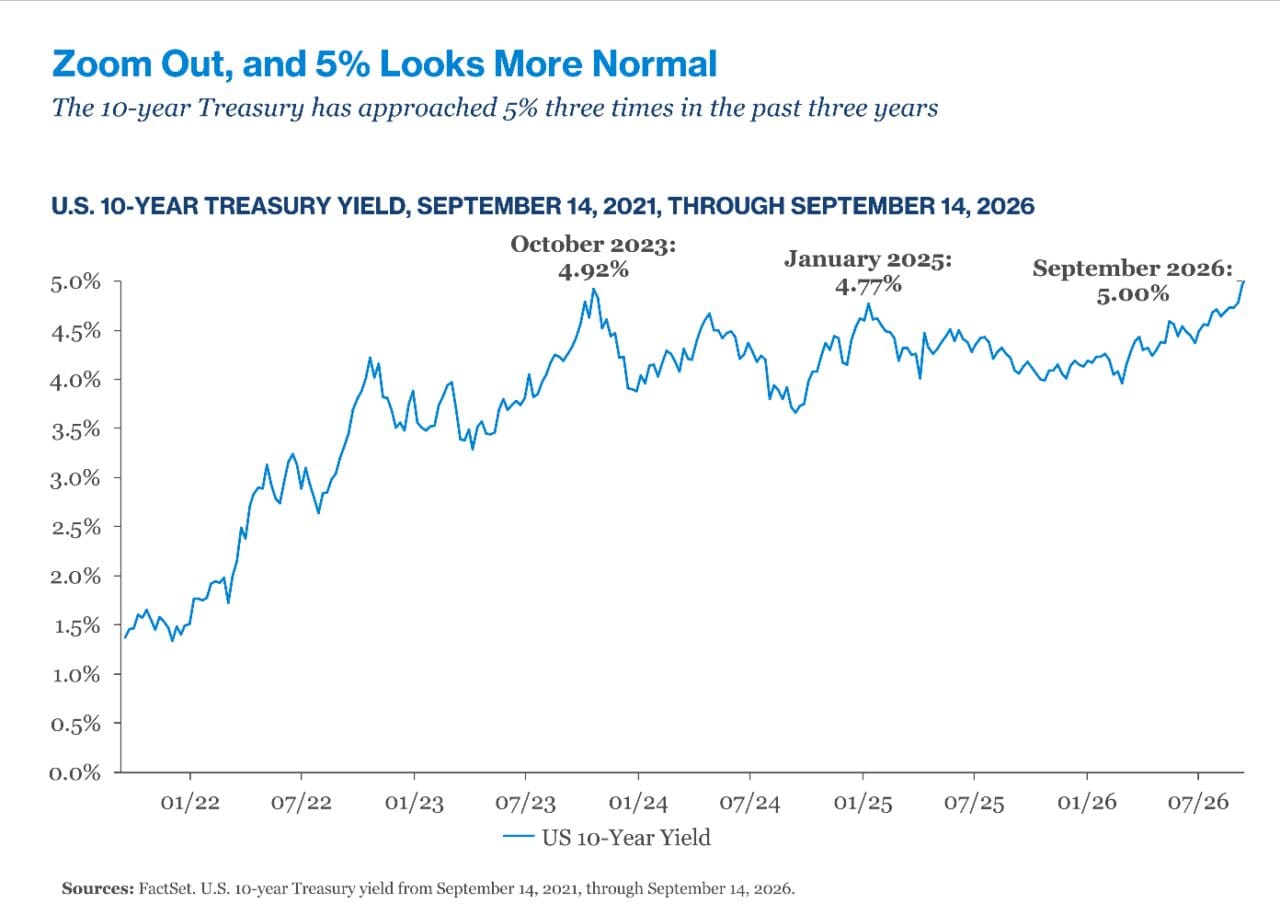
No one can reliably say where yields will peak, and they could move higher still. But today’s level is neither unprecedented nor, by itself, evidence that the bond market is breaking.
Higher Starting Yields Make Bonds More Resilient
The reason the recent rise in rates stings less than 2022 comes down to bond math. A bond’s interest income cushions the effect of rising rates, and that cushion is much thicker today. Heading into 2022, the 10-year Treasury yielded about 1.5%. Today, it yields roughly 5%. The chart below applies the same hypothetical one-percentage-point rate change to both starting points.
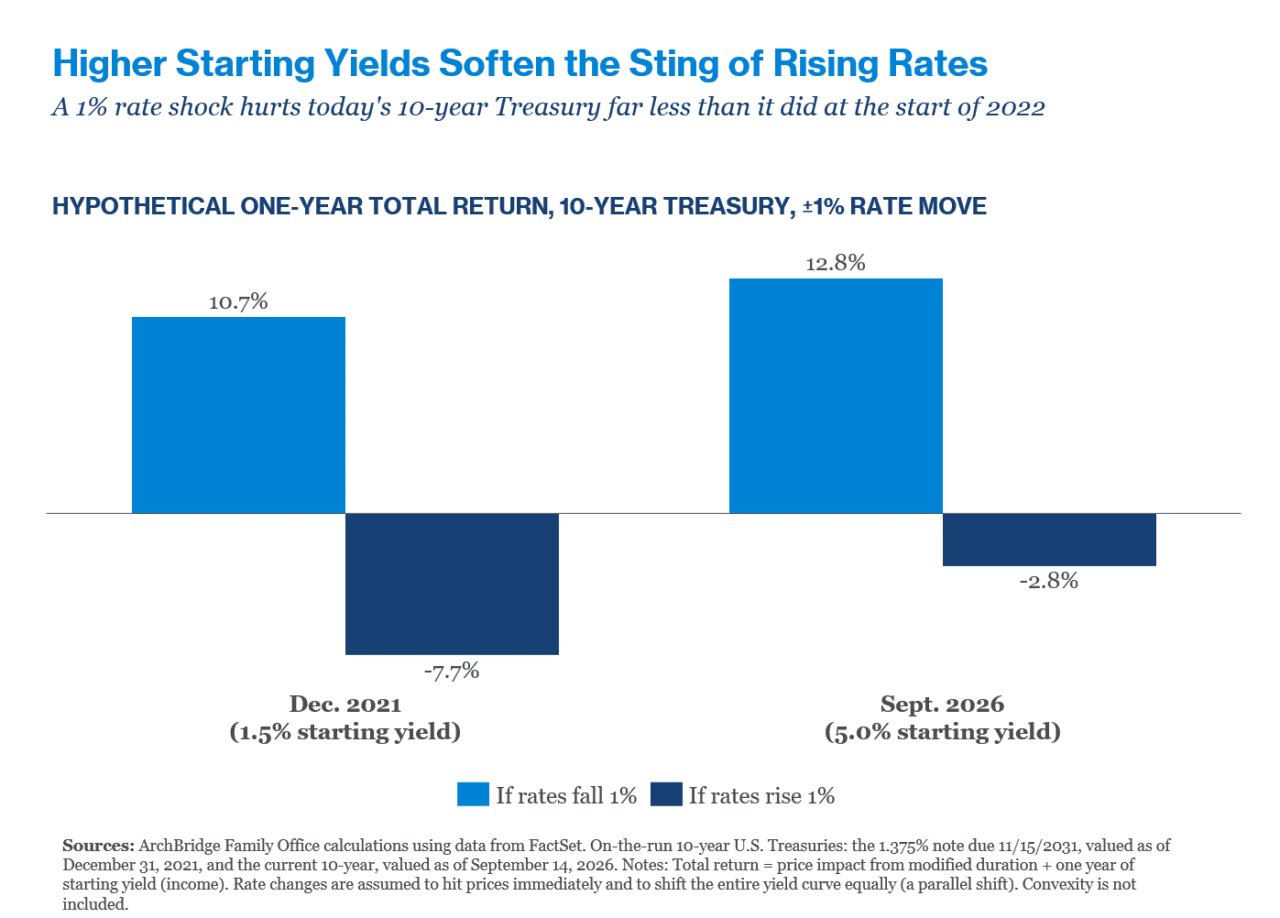
Hypothetical illustration for educational purposes only. Does not represent any ArchBridge portfolio or actual investment results.
In other words, the same rate increase that would have cost investors nearly 8% heading into 2022 would cost less than 3% today. The reason is income. On a $1 million investment, today’s 10-year Treasury pays about $50,000 a year in interest, compared with about $15,000 at the end of 2021.
Today’s 10-year Treasury pays roughly 2.5% a year more than expected inflation, compared with less than inflation in 2020 and 2021. And over time, rising rates work in investors’ favor, as interest payments and maturing bonds get reinvested at higher yields.
Why We Own Bonds, and Why We Stay Intermediate
The reasons for owning bonds haven’t changed. We want them to do three things: provide income, add stability when stocks decline, and provide flexibility to fund near-term cash needs and rebalance when markets are down, including when attractive opportunities appear.
We recommend intermediate-term bonds, a deliberate middle ground. They are less sensitive to rising rates than long-term bonds, while still locking in today’s yields for several years.
Investors who feel uncomfortable may be tempted to move shorter or hold more cash, which could be sensible in some cases, but comes with trade-offs. Shorter bonds and cash currently pay lower yields than intermediate-term bonds, so moving there means giving up income. They also benefit less if rates fall, which tends to happen during recessions and stock market selloffs, precisely when investors want their bonds to provide support. And cash yields can change quickly. They look competitive today, but they reset lower as soon as the Fed cuts short-term rates.
Where Bonds Fall Short
Bonds are not a panacea in every scenario. In an inflation-driven shock, stocks and bonds can fall at the same time, as they did in 2022. But if high energy costs and higher borrowing rates slow the economy into a recession, rates would likely fall, and high-quality intermediate bonds have historically helped cushion portfolios in those conditions. We don’t know which path lies ahead, which is why we build portfolios to hold up across more than one possible future.
What This Means for Your Plan
The best protection against unsettling headlines is a plan that doesn’t depend on them. When near-term spending needs are already set aside, no one has to decide whether to sell bonds, or stocks, based on what happened this week. That lets the bond allocation do its job over years rather than months, and it means a rate move is something to understand, not something to react to.
Bottom Line
Investors should resist making wholesale changes based on a flurry of rising-rate headlines. Watching bonds tread water while stocks climb can be frustrating, but stocks and bonds serve different purposes. Eventually, stocks will decline, and no one can reliably predict when. Maintaining a strategic, intermediate-term bond allocation preserves the income, stability, and flexibility investors will value when that happens.
This article is for informational purposes only and does not constitute investment, tax, or legal advice. Past performance is not indicative of future results. Please consult your ArchBridge advisor or other qualified professional before making financial decisions.
ArchBridge Family Office is an independent, multi-family office and trust company that advises clients on more than $15 billion of investment assets and more than $18 billion of total wealth. Founded in 2002, ArchBridge provides holistic, high-touch client service including customized, independent investment management and a full range of family office and fiduciary services.