
INVESTMENT MANAGEMENT
It’s Still Okay to Be Invested Near the Top of the Market
NOVEMBER 5, 2026




Key Takeaways:
- Market Highs Aren’t a Signal to Sell. New highs are more common than investors may think, and successfully timing the market requires getting both the exit and re-entry right.
- Diversification Matters, Especially Amid Uncertainty Around AI. Rather than trying to predict which companies, industries, or markets will win, a broadly diversified portfolio helps investors participate in potential growth while managing concentration risk.
- Focus On What You Can Control. Shore up near-term cash, rebalance back to your target allocation, stress-test the portfolio against significant declines, and let your long-term plan, rather than market forecasts, drive investment decisions.
In March 2021, I wrote a Forbes column titled “It’s Okay to Invest Near the Top of the Market.” Clients were concerned that stock valuations looked frothy, and I argued that waiting for a better time to invest is usually a mistake because timing market tops and bottoms is difficult.
The S&P 500 peaked nine months later and finished 2022 down about 18%, and for a while the worriers looked right. But even at its October 2022 low, the index was less than 10% below where it stood when the column ran. Since then, it has more than doubled, up about 108% with dividends through September 2026.
Now we’re hearing the same worry in a new form. Stocks are near record highs, bond yields are near 5%, inflation is back up to 3.7%, and AI has people euphoric, terrified, or both. More clients are asking whether they should sell some of their stocks. Our answer hasn’t changed. Selling because your plan calls for less risk is discipline. Selling because you think a drop is coming is a bet, and the odds are against you.
Why Selling Rarely Pays
The worry we hear most is that the market is at a record, so it must be due for a fall. But records aren’t rare. Since 1950, about one month in four has set a new high for the S&P 500, and returns from those highs over the following five years have been only slightly below average.
And even if a drop does come, selling only works if you get two calls right: when to get out and when to get back in. The second is harder. Markets turn before the news does. The S&P 500 bottomed on March 9, 2009 in the midst of the Great Financial Crisis, when the headlines were at their worst. Unemployment kept rising for seven more months, and by the time it peaked at 10%, stocks were already up more than 50% from the low.
In most years, getting out is the wrong call to begin with.
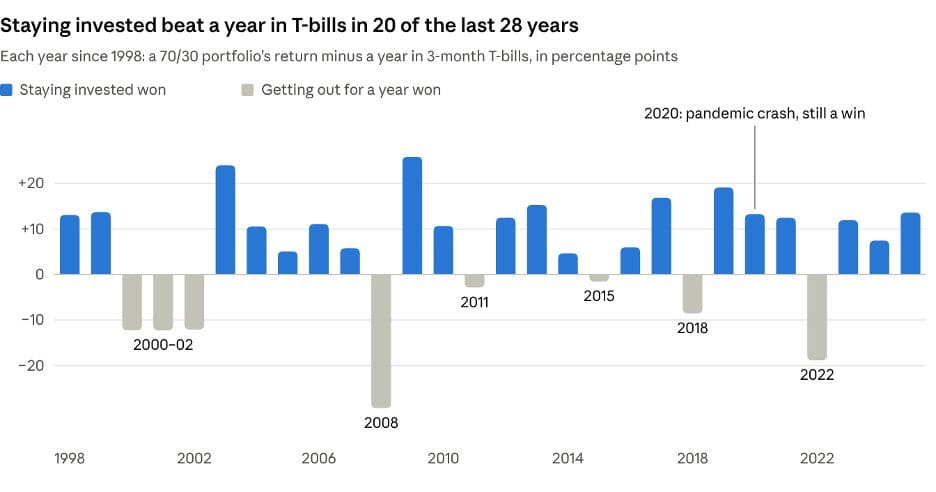
Since 1998, a 70/30 global portfolio of stocks and bonds has outperformed Treasury bills in 20 of 28 years. The chart marks the losing years. Look at what isn’t among them: 2020, when the pandemic shut down the world and the S&P 500 fell 30% in about a month, the fastest drop in its history. If there was ever a year to sell, that looked like it. From the March 23 low to year-end, the S&P 500 rose nearly 70%, and the 70/30 portfolio finished 2020 up about 14%.
The chart also leaves out taxes. A top-bracket family selling stock it has held for years owes 23.8% of the gain in federal tax, so getting out can cost far more than these numbers show.
History makes a strong case for staying invested. The pushback we hear is that history may not apply this time.
What if This Time Really is Different?
Sir John Templeton called “this time it’s different” the four most dangerous words in investing, meaning that market patterns tend to repeat. Yet, with AI, this time really might be different, and some of the people building it are saying so. In September, Jacob Coxon, a researcher who worked at OpenAI and Anthropic, quit and posted a warning on X that “the people building AI earnestly believe that it could kill us all by the end of the decade.” It was viewed more than 150 million times. On October 26, Anthropic filed to go public, and its S-1 has more than 90 pages of risk factors and warns that AI could pose “catastrophic or existential risks to humanity.”
We can’t rule that out. But we’ve learned that you can’t invest the bulk of your portfolio for the apocalypse. The AI scenarios that worry investors fall into two broad categories (neither of which is a prediction).
In the first scenario, things get bad, but the world and the financial system keep working. Maybe the AI-driven stock market is a bubble that bursts, ushering in a dot-com-like bear market. Or maybe AI is truly a game changer that delivers medical and scientific breakthroughs but also reorders the global economy in a hurry, with some big winners, many losers, and whole categories of jobs gone. Either way, diversified portfolios are built for this. It would be painful, but diversified portfolios have recovered from every bubble so far, though it took years after the dot-com crash. Investors concentrated in one market have fared worse. Japanese stocks took 34 years to regain their 1989 peak, which is one reason we recommend owning more than just stocks of a single country. We’ve seen this movie before.
Which industries win and which lose is impossible to predict, with too many second-, third- and fourth-order effects to sort out. That’s another argument for owning a broad slice of the market. If AI does create enormous value, much of it will go to the people who own the businesses making it and using it. So, sitting on too much cash is a risk as you’ll miss those gains, and inflation chips away at what you have.
In the second scenario, AI goes badly wrong and the systems we all depend on stop working. In that world, your portfolio probably doesn’t matter, and neither does your cash. A Treasury bill is a promise from the U.S. government, and a money market fund is a number on a statement. Selling to protect yourself from that is a bet on the one outcome in which the bet can’t pay you.
That doesn’t make the worry silly, and we’d rather talk about it openly than let it quietly drive decisions. For some families, it’s reasonable to hold a modest amount of real assets, like farmland or gold, which also help against inflation, and to plan for disruptions the way many already do for a hurricane or a long power outage. We treat it like insurance: a small amount, decided in advance, and not increased every time the headlines get scarier. If this is on your mind, bring it up with us.
What to Do Instead of Selling
Staying invested doesn’t mean doing nothing, and selling some stocks is fine when your plan calls for it.
- Shore up your cash. Keep at least a year of planned withdrawals, and maybe as much as 18 months to two years, in cash or short-term Treasuries. That will give you the liquidity to ride through most bear markets without having to sell stocks while they are down.
- Rebalance. Global stocks returned about 22% in 2023, 17% in 2024, and 22% in 2025, and they are up another 13% this year. A 70/30 portfolio left alone since 2023 is now about 80/20. Selling stocks to get back to your target takes chips off the table without trying to call the top. Where you can, rebalance in IRAs or with new cash, so it doesn’t trigger the tax bill described above.
- Stress-test your allocation. If your life has changed since you set your allocation, through a business sale, retirement or a different spending plan, revisit it now rather than in the middle of a crash. Start with what a drop in stocks would do. Here’s a $20 million portfolio at 70/30, assuming bonds hold their value (in 2022 they didn’t).
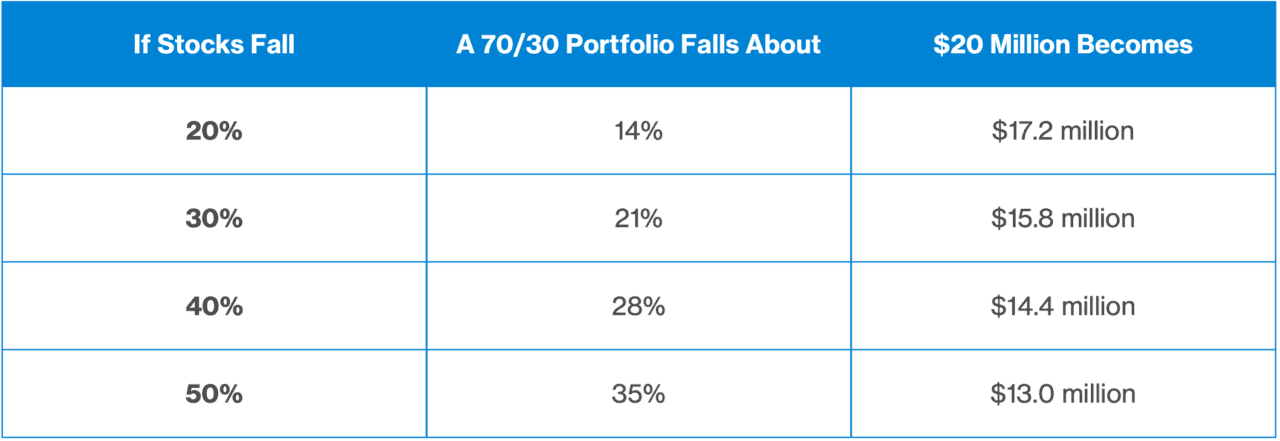
- Ask whether a drop like that would change how you live, and whether you could stand it. If the honest answer is that it would be too much to bear, lower your stock allocation now, as a permanent change to your plan rather than a bet on timing. If you think you can ride out declines like that, decide in detail what you’ll do when the market is down 40%. It’s much easier to stick with a plan you’ve already rehearsed.
- Don’t give up on bonds. The Bloomberg U.S. Aggregate Bond Index lost about 3% in total from the start of 2022 through September, nearly five years with nothing to show for it. But the rate increases that caused those losses make bonds a better buy now. The 10-year Treasury yields about 5%, up from about 1% in early 2021. Diversified municipal bonds yield over 7% on a tax-equivalent basis for top-bracket investors. Bonds have a real job in the portfolio again.
The Hardest Time to Invest is Now
There’s an old saying in our business that the hardest time to invest is now. It was true at the bottom in 2009, it was true when I wrote that column in 2021, and it’s true today with the markets near all-time highs and AI capability accelerating. It applies just as much to staying invested as to putting new money in.
No bell rings at the top or the bottom. Shore up your cash, rebalance, stress-test your allocation, and stay invested.